
Multimeter or oscilloscope…. How about the QST-5?
Multimeter or oscilloscope…. How about the QST-5?
Nowadays, for auto mechanics, accurate diagnosis of vehicle defects is crucial for successful repair. You should consider choosing a tool that will allow you to quickly and accurately examine the electrical and electronic systems in cars.
In this article, we’ll take a look at the popular tools used in diagnostics – the multimeter and oscilloscope – and show you how to speed up your work by using specialized sensor testing equipment.
A good multimeter in the workshop
When choosing dedicated equipment for an auto repair shop, it is important to pay attention to several important features and functions that can significantly facilitate the work of auto diagnostics:
- Measurement ranges and accuracy. Most available multimeters have voltage and current ranges that are quite sufficient for making measurements of electrical systems in vehicles. Similarly, the basic accuracy parameters do not need to be exorbitant 0.5% is a satisfactory level in the workshop. Higher resolution can be useful – multimeters that show hundredths of an Ohm over a range of resistance will prove especially valuable. Resolution is usually expressed as the number of digits of the result or the maximum number in which we read the measured values.
- Specialized functions. It is worth looking for a meter with features dedicated to automotive diagnostics, such as frequency measurement or PWM signal filling. This function will allow us to meaningfully check the control of actuators such as adjusters or valves.
- Resistance to working conditions: The multimeter should be sturdy and resistant to the conditions of an automotive workshop, such as shock, dust, grease or moisture.
- Safety. It is advisable to choose a meter from a reputable company with adequate protection on all current ranges. Safety issues take on particular importance when working with hybrid and electric drives.

What a digital oscilloscope is useful for
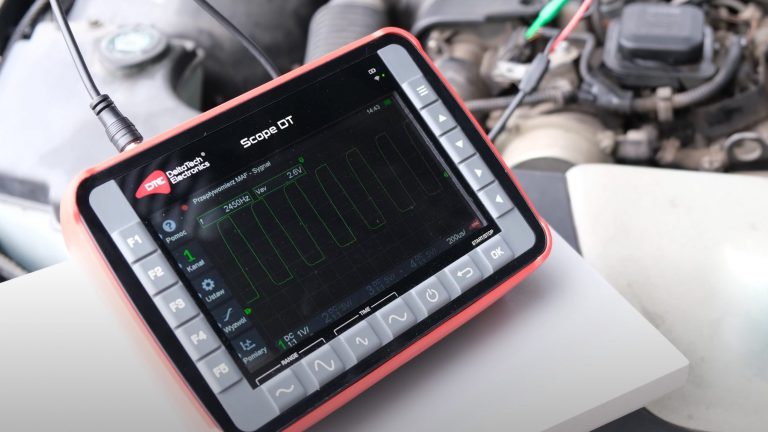
Digital oscilloscope, such as Scope DT oscilloscope , is an indispensable diagnostic tool in the automotive workshop, enabling accurate analysis of electrical signals in vehicles. When choosing an oscilloscope for the workshop, it is worth checking what input voltage it accepts, also whether it has appropriate probes and available accessories such as current clamps. In the case of an oscilloscope, the accuracy of voltage measurements is not at all the main factor characterizing the equipment.
Some prefer oscilloscope attachments that attach to a computer via USB, while others will choose stand-alone devices that display waveforms on their own screen. There are both bench-top oscilloscopes, which require mains power for operation, and portable devices, powered by a built-in battery. Two channels allow you to perform typical as well as more advanced measurements.

The sampling rate for automotive is not the most important thing (unless you intend to diagnose high-speed buses like FlexRay or MOST). Some oscilloscopes distinguish isolated or differential channels, which ensure maximum safety of measurements and minimize the risk of component damage.
Other specialized functions such as analysis of communication protocols will only find use if the user can use them. Good oscilloscopes are those that we will use regularly. More important than memory or the number of runs per second turn out to be clear interfaces and convenient-to-use software.
What are the advantages of working with an oscilloscope:
- Real-time signal analysis: The oscilloscope allows you to observe voltage changes in real time, which is indispensable for diagnosing complex electrical problems
- Testing digital and analog signals: With the ability to analyze both digital and analog signals, the oscilloscope enables comprehensive diagnostics in modern vehicles.
- Detection of interference and unusual phenomena: The oscilloscope allows the detection of unusual phenomena, such as voltage pulses, fluctuations or interference, which can be difficult to detect with an ordinary multimeter.
What is the QST-5 and what is it used for?
The QST-5 sensor tester is a diagnostic tool for testing various types of sensors used in automotive applications. The tester supports many types of popular sensors used in vehicles. The QST-5 can be used both inside and outside the vehicle, as it provides its own power supply for the sensors under test. The instrument has a cable that ends in three wires with terminals that allow connection to the sensor.

Practical examples
Modern vehicles are equipped with complex electrical and electronic systems that are responsible for controlling almost every aspect of the car’s operation – from engine management and safety to comfort and performance.
A key role in these systems is played by sensors, which are the eyes and ears of vehicle computers, constantly monitoring and providing data on the status of various components and systems. We will see what specific capabilities the devices under consideration have when testing specific elements.
Temperature sensor
- Multimeter – measure the resistance of the sensor and the output voltage during operation.
- Oscilloscope – we will get the voltage on the sensor during operation, just like a multimeter. The voltage graph is so slow that we have to choose a time scale of at least 10 minutes per plot to see the dynamics of change.
- QST-5 – you will get the resistance of the sensor (similar to a multimeter), and after selecting the scale (for typical sensors) also the temperature value from the sensor.

ABS sensor
- Multimeter – we should not connect a multimeter to active ABS sensors.
- Oscilloscope – make visible the signal waveform of the sensor pulses – we can pay attention to the uniformity of the generated pulses. After proper configuration, we can read such parameters as frequency and other signal parameters.
- QST-5 – we will get information about the current levels flowing through the sensor. We will also read the instantaneous value of the signal frequency, and easily count the pulses as the wheel rotates. We can indirectly assess the uniformity of the generated pulses by observing the blinking of the LED light
Crankshaft sensor (passive)
- Multimeter – measure the resistance of the sensor.
- Oscilloscope – see the output voltage waveform during operation. We will measure the amplitude, frequency and evaluate the uniformity of the shape. Visually detect problems such as damaged teeth on the pulser wheel or its “run-out” relative to the sensor.
- QST-5 – we will measure the resistance and inductance of the sensor. During operation (turning the starter with the controller disconnected), we will read the amplitude and frequency of the signal. The tester should indicate the number of pulses (teeth) on the pulser wheel.
Camshaft sensor
- Multimeter – we should not connect a multimeter to active camshaft position sensors.
- Oscilloscope – see the output voltage waveform during operation. Using an oscilloscope, we will measure the amplitude, frequency and evaluate the uniformity of the shape.
- QST-5 – we will determine the layout of the leads and the current drawn by the sensor. During operation (turning the starter with the controller disconnected), we will measure the frequency of the signal. Visually, an LED will allow you to assess the presence and uniformity of pulses.
Comparison
Based on the examples given below, we will show how each device performs in sensor diagnostics. Although this is only a fragment of workshop issues, it represents an important part of diagnostics and shows what we will use the equipment for in practice.
Multimeter
+ Versatility: measuring voltage, current and resistance.
+ Ease of use and easy accessibility.
– Multimeters are less effective in analyzing the complex signals that sensors in vehicles often generate.
Oscilloscope
+ Advanced Diagnostics: Allows observation of actual signal waveforms over time, which is important for diagnosing complex electrical problems.
– Requires more investment (higher price) and additional commitment to knowledge acquisition.
QST-5 tester
+ Ease of use: designed with the workshop in mind, it has a mechanic-friendly user interface.
+ Often does not require knowledge of the connection layout of the components under test.
+ Provides detailed information on the performance of typical sensors and allows them to be evaluated even outside the vehicle
Summary
For an auto mechanic without advanced training in electrical and electronics, the QST-5 may be the easiest tool to use. It is dedicated to a specific application – sensor diagnostics – and has a lot of facilities in this regard.
A multimeter is more versatile, but has many limitations, while a workshop oscilloscope in vehicle diagnostics offers by far the greatest diagnostic capabilities. But at the same time, it is the most demanding to handle.
Mechanics equipped with the right tools, such as the QST-5 tester, are able to quickly and effectively diagnose and repair sensor-related malfunctions, providing a comprehensive and professional service.